Cooperating for better care.

Affordable Care Act

Tag Archives

Tougher times seen coming for hospitals under Trump

depressed

Tougher times may be coming to hospitals under the Trump administration.

Whatever changes, including repeal, of course, occur to the Affordable Care Act, there will probably be “less coverage, or less generous coverage” in  insurance, Gary Claxton, vice president at the Kaiser Family Foundation, told CNBC.

“If you start with the hospitals, it seems unlikely that as many people will have coverage that is as generous as currently exists. So that means that when they go to the hospitals, they’ll have less money to pay with, or less insurance. So it seems unlikely this will be good for hospitals.”

Mr. Trump has pledged to repeal the ACA and replace it with a yet-to-be-announced plan. Congressional Republicans vow to back him.

Minda Wilson, a Los Angeles healthcare lawyer and author warned CNBC about potential damage to hospital reimbursement from the plan to changing Medicaid to a block-grant program for the states. “I think the hospitals are not going to do well, period,” she said.

This may be reflected  in the fact that the stocks of the for-profit hospital chains have all fallen a lot since Mr. Trump’s  election.

To get the CNBC report, please hit this link.


Some GOP governors to try to block Trump efforts to stop Medicaid expansion

block

GOP governors in several states will push back against any Trump administration efforts to stop or reverse the Medicaid expansion that has taken place under the Affordable Care Act.

Ten states approved expansion under Republican governors, and even GOP-dominated statehouses.  The Wall Street Journal reports that ending  Medicaid expansion would take away insurance coverage for millions of Americans,   creating a political backlash as a result.

The WSJ noted that Medicaid expansion “has also slashed uncompensated care provided by the nation’s hospitals by billions of dollars annually. The states that have yet to expand Medicaid have forfeited hundreds of billions of dollars in federal funds.”

“Right now a lot of Republican governors expanded Medicaid and they have said they will fight to keep it,” Caroline Pearson, a senior vice president at Avalere Health, told the publication. Meanwhile prominent Trump supporter and former Arizona Gov. Jan Brewer told the Associated Press that she wants the Trump administration to see Arizona’s Medicaid expansion as model of cost-effectiveness.

To read the WSJ article, please hit this link.


GOP threats may cause insurers to quit exchanges

flee

”Greeks fleeing the Destruction of Psara in 1824,” by Nikolaos Gyzis.

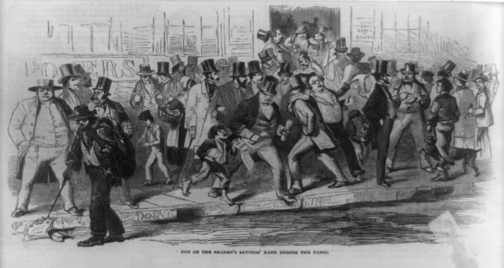
Many observers think that Republican threats to dissolve the Affordable Care Act could lead many insurers to bail out of the insurance marketplaces for individuals at the end of next year.

No one seems to know whether the right-wing Republicans about to control the federal government will carry out their threat to immediately kill the ACA in January or more gradually dissolve it. But even the latter is bound to cause enough confusion, disruption and anxiety to push out insurers.

FierceHealthcare reported: “{E}ven  {just} the prospect of a repeal—or a reconciliation bill with a delayed effective date—would disrupt existing markets. The federal government announced earlier this month that insurers must file proposed premium rates by May 3. If there is still uncertainty surrounding the individual marketplace, payers are likely to pull out altogether….”

T0 read more, please hit this link.


Healthcare leaders deeply fear ACA repeal

panic

A Modern Heathcare survey of healthcare CEO’s found great concern verging on panic that the Trump administration, whose campaign rhetoric has been stridently and ideologically in favor of “repealing” the Affordable Care Act, would do just that abruptly, causing economic and clinical chaos in the sector and  leaving millions of Americans without insurance.

“You can’t drop 20 million people from the insurance rolls,” said William Conway, M.D., who is CEO of the 1,200-physician Henry Ford Medical Group in Michigan. “I hope there’s no way to go back.”

“I would hope and pray that we don’t unwind the thing without anything to replace it.”

A Modern Healthcare Power Panel survey in May found that 67 percent of CEOs opposed repealing and replacing the ACA.

Modern Healthcare noted:

“Republican leaders are debating whether to quickly pass a repeal of most of the ACA, possibly with a one- or two-year delay, then later craft a replacement package. But 86% of the CEOs responding to the survey either strongly or somewhat agreed that repeal should not proceed without a replacement plan that provides affordable health insurance for all Americans who lack employer-based coverage.”

To read the Modern Healthcare on what many healthcare leaders see as a huge crisis of uncertainty, please hit this link.


Prospect of end to ACA spawns panic among some

panic

By JENNY GOLD

For Kaiser Health News

The 20 million Americans who have gained health coverage under the Affordable Care Act don’t yet know exactly how the presidency of Donald Trump will change their lives — and reactions to that uncertainty range from anxiety to apathy.

“My phone is ringing off the hook,” said Billy Bradford, an insurance broker in Montgomery, Ala. “People are just in panic mode here.”

One call came from an older couple who had recently retired. Right now, the couple pays $57 per month for their insurance plan; without the subsidy they receive through the health law, the cost will shoot up to $2,000 a month. “They called me in tears afraid. They would not be hired back at their old jobs and are in poor health,” said Bradford.

But another set of consumers — who perhaps are healthier or feel like they are paying too much for too little coverage — may welcome a change. Trump told The Wall Street Journal on Nov. 11  that the law would be “repealed and replaced or amended.”

On Nov. 13, Trump was upbeat but vague about what that change might be, telling 60 Minutes: “It’ll be great healthcare for much less money. So it’ll be better healthcare, much better, for less money.”

It’s been well-documented that the public remains deeply divided over the law, which has been controversial since it passed in 2010. A recent Gallup poll found that 51 percent of respondents are in favor of repealing Obamacare, while 45 percent oppose repealing it.

But of those Americans actually enrolled in either marketplace coverage or expanded Medicaid, about 80 percent say they are somewhat or very satisfied with the coverage, according to a survey by the Commonwealth Fund.

Denise Martinez Gascoigne, 49, in Greenland, N.H., has been paying $1,130 in premiums each month for insurance for her family of four that she purchases through the state’s exchange. Their deductible is $5,000 per person. Gascoigne and her husband are both self-employed and earn too much money to qualify for a subsidy.

“It’s so ridiculous that we pay over $1,100 a month, and we’re still left footing the bill for whatever prescription or procedure we might need in addition to the health insurance,” she said. “We just don’t go to the doctor.” Her premium is set to increase to nearly $1,330 in 2017.

Gascoigne, who is a Democrat, is “very disappointed and distraught” over the results of the election and supports a single-payer health system. Nonetheless, she said, she’s “somewhat indifferent” to the impending changes to the Affordable Care Act.

But in Crystal, Minn., Xochitl Mendoza Ramirez is far from indifferent. She fears that she will lose her coverage: “I felt like throwing up. The past two days, it’s been me having these moments of crying at work.”

Ramirez, 22, has made good use of the insurance she gets through her state’s expansion of Medicaid, the government’s program for low-income adults. “If it wasn’t for the Affordable Care Act, there’s no way I would have gotten my gallbladder out or even gone to the doctor. I just couldn’t afford it.”  She also relies on the insurance for therapy and medications for bipolar disorder.

Ramirez doesn’t know how she’ll get health insurance without the Medicaid expansion. She works two part-time jobs in retail, but neither provides health insurance. Any changes to the law are likely to take months or years before they go into effect, but Ramirez is already preparing for the worst.

“As soon as I found out he was elected, I started making phone calls to get an IUD,” she said, referring to an intrauterine device for long-acting birth control. She found a doctor to do the procedure this week.

Tuan Nguyen, 38, in San Jose, Calif., has been paying $105 for a subsidized plan on the exchange. Recently, he’s been diagnosed with digestive problems and acid reflux and was pleased that each doctor visit cost him just $5.

“I’m happy with the plan. I’m just sad to have it taken away from me right when I really need it,” he said. “If the subsidy goes away, I’ll have to pay full price. That’s close to $500 or so. I can afford it, but it’s something that will definitely take a chunk out of my income. It would be a crunch.”
Rebecca Geitz of Austin, Texas, said her subsidized premiums have been affordable, but her plan “is the most useless thing in the world. No one takes it!” When Geitz, 33, did get sick, her co-pays were so expensive that she said it was cheaper for her to just pay an urgent care clinic out of pocket. Nonetheless, she said, “I do know that if a serious emergency happened my coverage would help to some degree.”

If the law is repealed, she worries, she may not even have that. But he’s much more worried for his mother, who is being treated for Stage 4 lung cancer and receives her insurance through California’s Medicaid program.

Nguyen worries that if the Republicans change how they pay for Medicaid by making it block grant program, as they’ve promised, the funds for her $8,000-a-month medications could dry up. “I’ve thought about this the past few days. It’s been on my mind like crazy,” he said. “Right now she’s getting medication that’s extending her life. It could allow her to live years instead of months. … Are they going to pull the plug on her medications?”

Richard Coppola, 48, believes that the Affordable Care Act has been a failure. He pays $378 a month for a plan with a $2,000 deductible, and his premiums are going up to $480 next year.

But still, he said, he’s “terrified” about going back to a world without it. He worries about a system where he could be denied coverage for once having a mole removed years ago. He’s also concerned about lifetime cost limits being restored and the loss of subsidies for people with low incomes.

“The ACA is a piece of garbage,” Coppola said, “but the Wild West before was a lonely place.”



How the ACA dismantling might go

Paul Keckley, writing in Hospitals & Health Networks, predicts  that these things may happen in the early days of GOP efforts to dismantle the Affordable Care Act:

  • “Dismantling Healthcare.gov and transitioning control of the marketplaces to the states.
  • “Negotiating with congressional budget officers and the Department of Health & Human Services for the transfer of Medicaid responsibility to the states via block grants.
  • “Expanding tax credits and high risk pools for individuals and allowing purchases of insurance across state lines.
  • “And through legislative negotiations, transitioning oversight and subsidies for its 12 million newly insured to states over a period of several months.”

To read more from Mr. Keckley on the dismantling of the Affordable Care Act, please hit this link.


Obama challenges GOP to come up with a better health plan


President Obama challenged  President-elect Trump  and congressional Republicans to come up with a better healthcare program than the Affordable Care Act.

“Obviously, this has been the holy grail for Republicans: We gotta kill Obamacare,” the president said.

“If they can come up with something better that actually works, a year or two after they’ve replaced the ACA with their own plan, and 25 million people have health insurance and it’s cheaper and better and running smoothly, I’ll be the first one to say that’s great,” he said. “Congratulations.”


FQHC’s: More funds but big challenges


The Affordable Care Act has provided Federally Qualified Health Centers  with new financial resources. However, a new study from the UCLA Center for Health Policy Research  cites continuing  challenges at these centers, including the need for more stable revenue streams, sufficient staffing support, including training, and help in dealing with new reimbursement systems.

Researchers found  that most FQHC’s now see more patients than they did before the health law went into effect, contradicting  some earlier projections that newly insured people would leave the centers for private providers.

The number of insured patients using FQHC’s surged 35 percent, from 12 million in 2010 to 16.5 million in 2014, says the study.

“Most … saw an increase in the number of insured patients, both because they retained previous patients who became insured and because they attracted new insured patients,” researchers wrote.

The study also found that the number of immigrants seeking care at the centers grew 12 percent between 2010 and 2014, to 5.3 million. The 31  FQHC’s  studied also reported that a common reason that patients were ineligible for insurance was that they were in the U.S. illegally.

The researchers found  that federal grants  awarded to FQHC’s as a result of the ACA provided needed funding to help serve the growing numbers of people using CHCs, particularly in states that didn’t expand Medicaid.

But the researchers added that much of the new funding is temporary, presenting possible long-term problems. Particularly problematic may me the predictability of Medicaid funding.

To read the report, please hit this link.


Whither hospitals in the Trump era?

jungle

Michael P. Strazzella, practice group leader for federal government relations for  the law firm of Buchanan, Ingersoll & Rooney’s District of Columbia office and a healthcare expert, speculated in an interview what  might happen to hospitals in Trump administration that seeks to take apart the Affordable Care Act.

Among his observations:

“Repeal is good campaign language but it’s a 2,000-plus page bill and not everything can be repealed.”

Fierce said that he said that Republicans and  Mr. Trump don’t want to see millions of people suddenly losing their insurance.”The question the administration must grapple with is how to transition them so they can stay insured but also access more affordable health plans.”

But, he said, Mr. Trump can, in his first days of office, and without congressional approval,  withdraw the appeals of certain pieces of the law that are caught up in lawsuits. He can take action immediately on the appeal to cost-sharing subsidies, insist that the Department of Health and Human Services direct reinsurance payments back to the Treasury Department, and refuse to pay out risk corridor payments.

But,  Fierce asked, “where does this leave hospitals and healthcare systems that have agreed to cost-sharing proposals under the Medicare program if the ACA is rolled back?

He said there will be concerns about the additional costs involved in policies and programs put in place to replace the ACA.

“I believe people need to take a hard look at their business models, where they fit in to Republican proposals driven by Trump,” Mr. Strazzella says.

As for some of the ACA pilot programs, such as the Accountable Care Organizations under the Medicare Shared Savings Programs that were endorsed by the Obama administration? Mr. Strazzella expects the Trump administration to take a close look.

“President Trump will not be shy to hold back on those if he is not seeing the dollar savings and see if he can do it better in a different form.”

He also noted that Mr. Trump has talked about moving people off Medicaid and to private  insurance.

To read the whole interview, please hit this link.


If Trump tries to repeal the ACA…

pour

Timothy Jost, a healthcare-law expert and a professor at Washington & Lee University, gives his take in Health Affairs on the implications of Donald Trump being elected president and of the Republicans maintaining their control of Congress.

First, he notes the obvious:

“President Trump will be able to appoint at least one Supreme Court justice almost immediately and possibly more during his term in office. He will also appoint dozens of district and appellate court judges. Finally, he will presumably replace the cabinet secretaries and most of the political appointees in the Departments of Health and Human Services, Labor, and Treasury — that administer the Affordable Care Act. The Republicans  {will} own the national government, and many state governments.”

He goes on:

“Donald Trump states at his website, ‘On day one of the Trump Administration, we will ask Congress to immediately deliver a full repeal of Obamacare.’ If by Obamacare Trump means the Affordable Care Act in its entirety, this will not happen. First, any repeal proposal would be subject to a filibuster in the Senate and the Democrats retain more than enough votes to stop a repeal bill. Second, the Affordable Care Act contains hundreds of provisions affecting Medicare, program integrity, the health care workforce, biosimilars, prevention, and other issues unrelated to what most Americans think of as ‘Obamacare.’ Immediate repeal of the ACA and presumably restoring the law that preceded it would likely bring the Medicare program, for example, to a halt until new rules could be written. The ACA is inextricably interwoven into our health care system and is not going away immediately.”

“Congress and the President, can, however, repeal many of the provisions that are identified by the public as ‘Obamacare’ using the budget reconciliation process. A budget reconciliation bill can be passed by a simple majority and cannot be stopped by a filibuster. The final ACA in 2010 contained provisions passed through the budget reconciliation process after the Democrats lost their filibuster-proof majority.”

“Importantly, reconciliation legislation could probably not change the insurance reform provisions of the ACA—the ban on preexisting condition exclusions and health status underwriting, caps on annual and lifetime dollar limits, actuarial value requirements, age underwriting restrictions, as they do not affect revenues and outlays. The continued imposition of these requirements without the financing provided by the ACA could cause serious distortions and damage in insurance markets. …”

“Repeal would, moreover, raise the question of what would replace the ACA. The Congressional Budget Office estimated that enacting the 2015 reconciliation legislation would increase the number of uninsured Americans by 22 million. The legislation would have delayed the end of the premium tax credits until 2018 to allow time for replacement legislation, which was not part of the bill.”

To read Mr. Jost’s very useful piece,  please hit this link.


Page 8 of 29First...789...Last

Contact Info

info@cmg625.com

(617) 230-4965

Wellesley, MA